
I could spend hours going through my poor brain to think of a new post idea and that doesn’t sound appealing. Thus, I once again turn to the mighty ChatGPT (I asked the same question a while ago about exercising):

ChatGPT came up with ten questions but I filed two under the ‘this is stupid I don’t like this’ category and we are left with eight. Let’s go.
1. What is the best diet for weight loss?
A 2017 review by The International Society of Sports Nutrition (ISSN) noted:

A 2014 meta-analysis looked at 48 randomized trials including 7286 individuals and a crapload of different diets and concluded:

READ: If I told a bunch of people to follow the same diet, it might work for one person but not another. There’s no one-size-fits-all dietary approach when it comes to weight loss. The good thing about it is that you can tailor things to suit your specific needs, preferences, lifestyle, and schedule.
The ultimate goal is to find an approach you can stick to not for a week or three but many months and eventually, years. The ‘best’ diet is irrelevant if you don’t like it and you cannot adhere to it.
2. How many calories should I eat in a day to lose weight?
Take a look at the embarrassingly childish drawing I’ve made below. This is what you need to do:
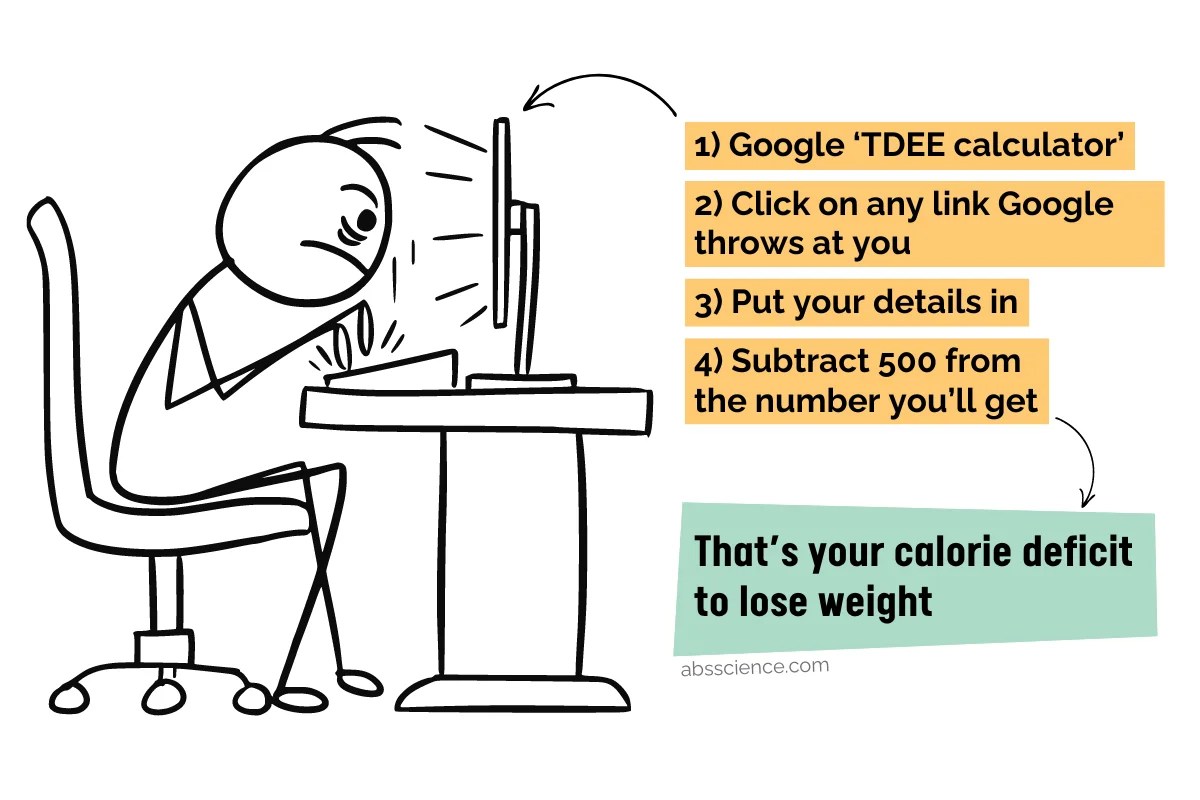
A few things to keep in mind:
- Many people suffer from the ‘I’m 100% in a calorie deficit, I’m tracking everything I eat and drink, yet I’m still not losing weight, what an actual duck, Egis?’ phenomenon.
No, your metabolism isn’t broken and you’re not diet-resistant. The general population has been found to underreport their calorie intake by as much as 47%. Even dietitians have been found to underreport their calorie intake by about 223 kcal/day. So ensure you’re 100% consistent with a calorie deficit. - If you’re 100% certain that you’re spot-on with food tracking and still not losing weight following the number the TDEE calculator gave you, you need to adjust it. That’s because all these calculators are based on averages and individual variability can play a role. I recommend waiting at least four weeks before making any adjustments.
I wrote the ‘When & how to adjust calorie intake when dieting’ article a while ago so we’re done here.
3. Are low-carb diets effective for weight loss?
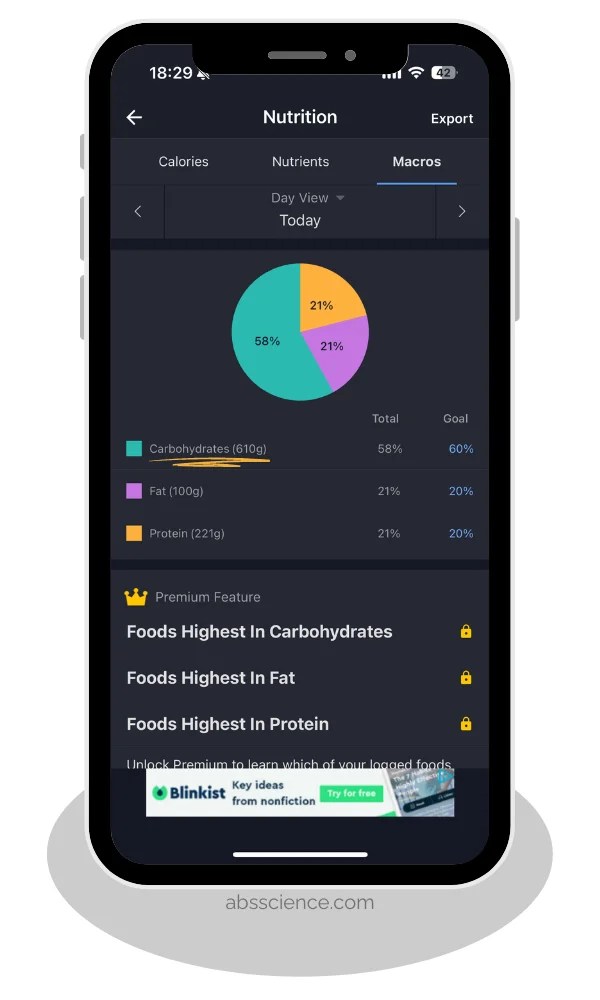
To date, no controlled, isocaloric aka calorie deficit diet where protein is matched between groups has shown a meaningful fat loss advantage to the low-carb or keto diet.
While carbohydrate restriction can work for some people, that’s not something I’d recommend to my clients. It’s no better than higher-carb diets and it can be unsustainable for heaps of people. But if you think going low-carb is something you can stick to, that’s great news for me because I love carbs, so more carbs for me:
4. What are some healthy snacks for weight loss?
Snacking is ridiculous in every possible way. Seriously, if you want to lose some weight pretty easily, just don’t snack. And yes, even if it’s the ‘healthy’ stuff. My gripe with snacking is…
- First, most people don’t snack because they’re hungry. They just mindlessly eat all day. It’s comfort for them.
- Second, most snacks people eat traditionally are high fat and high carb, which = a boatload of calories. I would be totally okay with snacking if people ate fruits, berries, or lean protein. But that’s not how people eat. You don’t see people walking with a little chicken stick in their hand, do you? That would be considered potentially insane.
So snacking, by default, is just extra calories. It’s not conducive to weight loss. If you want to make calorie management easier, try not to snack outside of regular meals.
Look at your lifestyle and schedule and decide how many main meals per day you want to eat. Most people I work with fall between 2 and 4 meals per day. Schedule specific times for those meals. Stick to that meal frequency and timing. Make it mechanical eating and eliminate snacking.
5. Is intermittent fasting a good way to lose weight?
Time-restricted eating that typically involves a fasting window of 16–20 hours and an eating window of 4–8 hours daily bears no significant advantage over daily caloric restriction for improving body composition. So whether you fast or not should come down to your preference, lifestyle, schedule, and training goals.
And I don’t want to hear all this ‘But what about autophagy and living to 150 years to see my grand grand grand grand grandchild?’ crap. I promise I’ll put my hands around my head and scream.
6. What are superfoods and how can they benefit my diet?
Did you know that kale is the food most mentioned as a ‘superfood’ on websites? I hate kale to hell and back so that alone permits me to say there’s no such thing as ‘superfoods.’
Yes, some foods do contain more nutrients than others. However, no food will help you lose weight on its own.
7. Are supplements necessary for a balanced diet?
My initial thought was to just say ‘No. Let’s move on.’ But unlike many charlatans on the web trying to sell you diarrhea tea, I give a shit about this fitness thing so here’s some nuance.
Supplements contribute to your diet very minimally and adding them to your diet is a matter of personal choice.
Protein powder is great if you struggle to get enough protein. It’s super convenient too. Creatine is awesome for gym performance (no, it doesn’t cause hair loss, stop it, you silly). Multivitamins, omega-3, vitamin D, etc. are up to your personal preference.
8. How can I maintain a healthy diet while eating out or traveling?
If you look at the progress tracker of one of my clients, you’ll catch the idea of what my recommendation for eating out is:
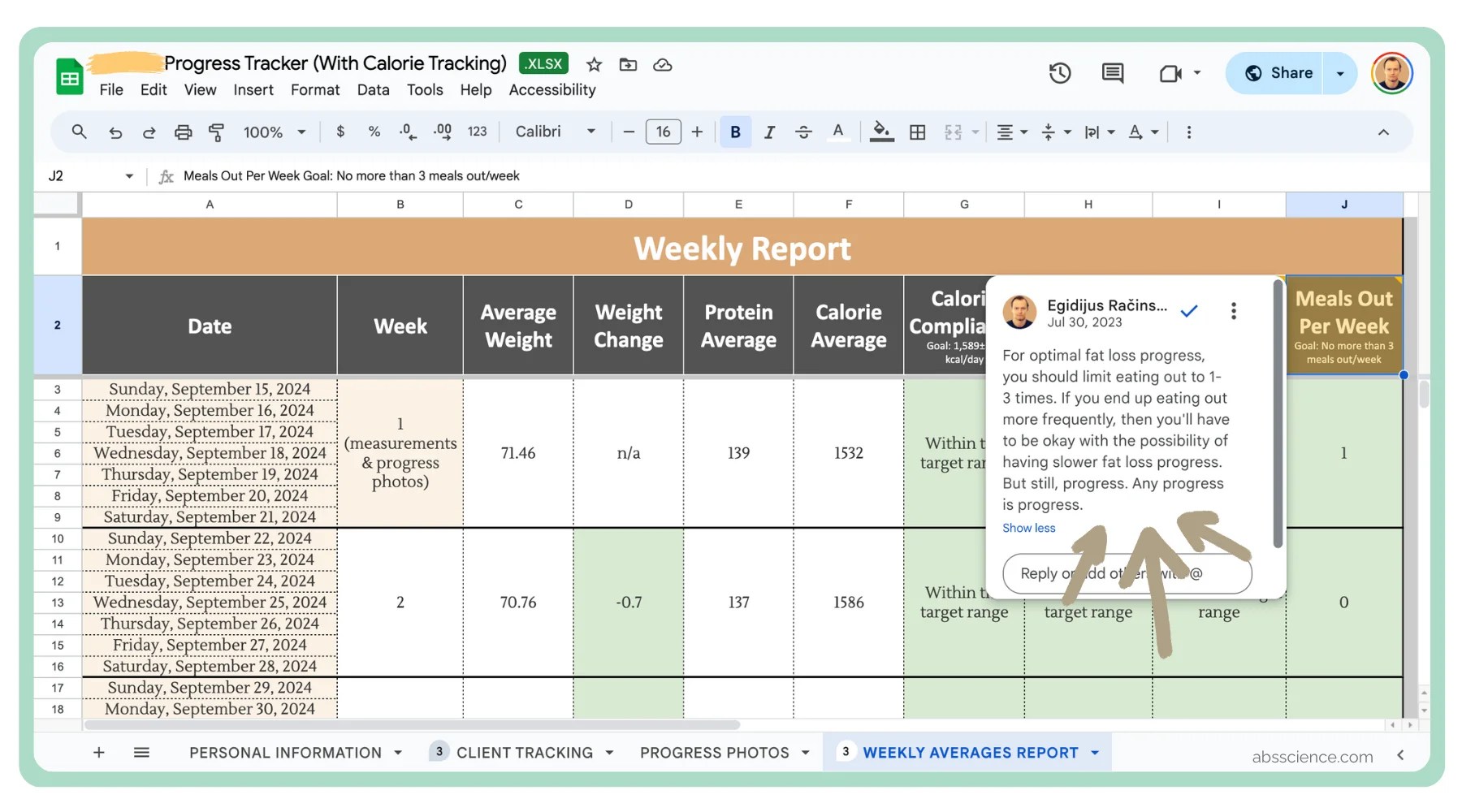
Eating out less frequently is your best bet unless you’re okay with a slower rate of weight loss. I mean…
Restaurant chicken salads can range from a couple of hundred calories up to a couple of thousand, depending on the quantity and ingredients. Sometimes you look at chicken salad, and you’re like, ‘No, I don’t know what that is, but it sure as hell isn’t chicken salad.’
So you’re best off limiting eating out to no more than three times a week and even then you still have to have some structure:
- Utilize some sort of calorie cycling — if you know you have a dinner planned ahead of time, you can eat fewer calories during the week and/or the day of the social event so you have more wiggle room. This doesn’t mean starving yourself bat-shit crazy. Just allocate more calories for lean protein, veggies, and fruits. Foods that are filling.
- Try to pick a meal that’s centered around protein — chicken breast, steak, fish, tofu, etc. The simpler the better.
- Stick to the ‘one plate rule’ — if you don’t want to look up menus and calorie information online beforehand to get an idea of what you’d like to order, then you want to practice portion control by ensuring everything you eat fits on one plate. This is a great option to keep your portions under control.
- Don’t do dumb things with alcohol — drink too much and the ‘one plate rule’ becomes the ‘five plate rule.’ And they’re all filled with desserts. I recommend limiting yourself to 1–2 beverages because whether you like it or not, alcohol contains 7 calories per gram.
This is by no means a full list of strategies. But for the sake of your sanity, let’s let good enough be good enough and move on.
Ultimately, you want to be able to focus on the people around you rather than obsessing over calories and macros. Have some structure but don’t come in with millions of hard and silly rules such as ‘order fresh fruit for dessert’ or ‘ask the staff not to leave the bread basket.’ That’s ridiculous.
Important note: Sometimes you just need to enjoy yourself. If it’s a special occasion, you want to go out and order what you feel tastes awesome rather than just ordering because it’s the lowest calorie option. Jen Broxterman, RD CEO Prosper Nutrition, uses the word ‘a joy choice’ for that, and I absolutely love that — sometimes, whether it’s your birthday or a date, you just want to enjoy yourself.
Now, the other part of the question — traveling. Luckily, I wrote the most fucktacular article on that right here. Go read it. Now. Seriously, go. This post is over. Because my head hurts. Bye.
~
If you want to avoid common beginner mistakes, apply for my 1:1 Coaching Program because I like money & those who do become my clients seem to get great results (check my Instagram page). Or…
If you want something free, sign up for my Weight Loss Formula that’s designed to help you create the foundation of good habits & sustainable strategies that set you up for long-term weight loss success (it comes with “5 pillars of weight loss”).
Originally published by me on Medium on the 8th of October, 2024


