
At the time of writing this post, it’s summer where I live (it’s Lithuania, if you’re wondering). Which means I’m lazy. Which is kinda like saying, “I’m a huge fan of ice cream,” in that who the fugg isn’t? So this is the second time I was too lazy to think of a topic to write about (I turned to my IG followers for help last time). Off to the ChatGPT this time:

I don’t know if what ChatGPT came up with is actually what people search for on Google or if it’s just something it dreamed up but let me answer the top 8 (whether you let me or not I’m still gonna do it because it’s my post so deal with it). Let’s go.
1. How many days a week should I work out?
Here’s my take on training frequency whether the goal is fat loss or muscle growth:
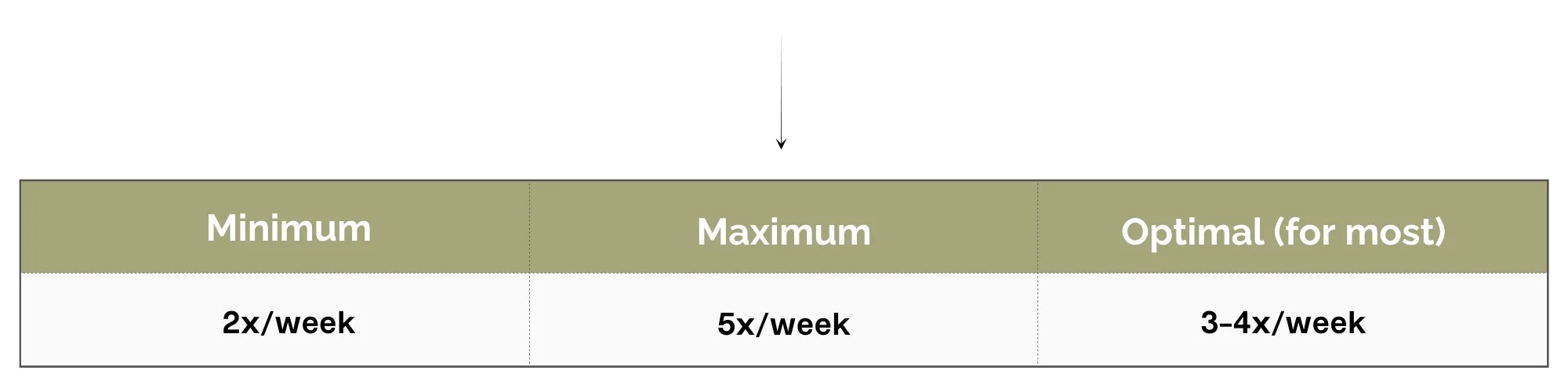
Now the nuance.
First, training frequency comes down to your personal preference and schedule. Second, even more important than training frequency is the total training volume (sets/muscle group) done in a week. For most people, 3-4 weekly workouts will be the optimal frequency to get in a sufficient amount of sets/muscle group/week.
2. What are the best exercises for weight loss?
Weight loss is all about creating and sustaining a calorie deficit in the most efficient way possible.
You need to go through a crapload of suffering to burn 500 calories through any kind of exercise. To create a noticeable calorie deficit to lose a substantial amount of weight at the end of the week, you’d have to exercise every day for at least 90 minutes. Not super efficient.
Don’t believe me? Well, there’s a cool study…

…in which researchers said fugg it let’s go mental cuz why not scientists keep the world spinnin’ and they made a bunch of identical twins to cycle stationary bikes twice a day for 9 out of 10 days. And they, wait for it, waaait for it, had to do it for 93 fugging miserable days.
Here’s the best bit—average body weight loss was 5 kg (11 lbs). But it gets better. To lose 5 kg in around three months, the subjects had to rub their ass into the stationary bike for 1.6 hours per day. And they did that almost every goddamn day.
What I’m trying to say is that exercise, any kind of, is pretty shit for burning calories (not to mention that some people tend to “eat back” calories they burn). However, exercise, progressive strength training specifically, is awesome for preserving/building muscle mass while in a calorie deficit. Which is one part of successful weight loss (lose fat + maintain/build muscle mass).
So you’re better off training for muscle growth and strength. Your diet should create the majority of the calorie deficit. As I said before, train for muscle and strength, eat for fat loss. Training to burn calories is silly.
3. How do I stay motivated to exercise regularly?
The question isn’t how to stay motivated to exercise. The question is whether or not you’ll go to the gym regardless of whether you’re motivated or not.
You see, motivation is fleeting. At some point, motivation will say to you we’re not going to the gym today let’s eat five bags of Oreos instead. It’s unrealistic to expect to be motivated all the time.
I don’t know who said this to whom but I love this quote:
“Motivation is doing things when you feel like doing them. Discipline is doing things regardless of how you feel.”
So don’t rely on motivation to get things done. Instead, set up habits and systems to discourage failure and encourage success. From my personal experience working with clients, the following two things will help you stick to your training when you aren’t motivated to do it:
- Don’t work out too much. As said before, 3–4 workouts per week is optimal for most people. Exercise too much and I guarantee you’ll find it unsustainable and unenjoyable.
- Track your workouts. Results keep motivation up. But you need something that confirms that you’re making progress. That’s where training logbook comes into play. If your gym numbers are consistently going up, you can be near damn sure you’re getting stronger and adding muscle (assuming your form isn’t deteriorating as the weight is going up). So log your workouts.
4. Is it better to do cardio or strength training for weight loss?
Geez, again? Go back to point #2. But before you do that, let me tell you something.
While you can lose weight by making better dietary choices aka don’t treat every meal like you’re about to climb Mt. Everest, you should still strength train because it signals your body to keep the muscle.
As I said in one of my articles, though I’ve no idea which one because I wrote a huge pile of articles which people forget about in a few days. Now I feel terrible and I think I should get a new job… Anyway, what I wanted to say was muscle loss while dieting is highly correlated with weight regain which I think everyone would agree, unless everyone is an imbecile, is suboptimal.
Now, cardio thingy. It doesn’t help with muscle preservation nor does it burn a whole lotta calories (just like strength training doesn’t). But… cardio is extremely important for your overall health.
So I strongly recommend you make it part of your training whether you want to lose fat or build muscle. Having “here rests artery-clogged hippopotamus who was too lazy to do cardio a few times a week” written on your grave is suboptimal either.
5. What are the benefits of stretching before and after a workout?
In this article, I said that static stretching where you stretch a muscle for about 30 seconds or more before strength training is silly and has negative effects on subsequent gym performance. This shit should be buried under a pile of tax returns.
As for “after a workout,” let’s put it this way: I haven’t done any post-workout stretching or cool-down in the past 15 years of my training. If you have serious mobility limitations or you simply like it, go for it. But it doesn’t hold some special properties and it isn’t essential.
6. How long should I work out each workout?
The total training volume that I mentioned before (sets/muscle group/week) and training frequency pretty much determine the length of your workout.
Say through trial and error you’ve found that 8 sets/muscle group/week produces the fastest rate of gains (remember, the optimal number of sets is highly individual and depends on various factors such as rest between sets, exercise selection, etc.).
You could cram all sets into one workout but that would probably keep you in the gym for like 4 fours. So you’re better off spreading that work over several workouts. Spread that volume over 3-4 workouts and your workouts will probably last 45-75 minutes.
And while there’s no best workout length—all the fluff about cortisol going through the roof after 90 minutes of workout is an absolute poo—I think most people will get the best results with 45 to 75-minute workouts.
7. Is it okay to exercise when sore?
I wrote all about delayed-onset muscle soreness and why it’s a shitty indicator of muscle growth here. What I didn’t mention is that there’s nothing wrong with training if you’re still sore from your previous workout.
Unless you fugged it up last workout and trained so hard that now you’re like boy oh boy my biceps achieved peak levels of pain Mum help me call the doctor I cannot fully extend my arms, it’s generally agreed that you’re safe to train again.
8. What are some effective ab exercises?
I’m done with the army of people in the gym doing a bunch of ab exercises in a circuit style. It accomplishes the square root of fugg all. Social media is full of these moronic ab routines.
Your ab muscles are no different from any other muscle that you train. Would you do five different chest exercises in a circuit style? I hope you wouldn’t because that would be stupid. Why would you train abs this way? Here’s how to train your abs effectively (for muscle growth specifically):
- Choose an exercise that you can do pain-free and feel your abs engaged. This will probably be some type of crunch-type movement (such as kneeling cable crunch) because the main function of the rectus abdominis muscle is spinal flexion. FYI, all the planks are pretty shit for that matter (although they’re good for core stability and general spinal health).
- Take that exercise within a few reps of failure (0-3 preferably) and take enough rest between sets to recover (at least 2 minutes ideally).
- Track your progress in that damn training logbook and apply progressive overload by increasing the resistance (weight) or doing more reps over time.
And that’s how you train abs effectively.
By the way, that’s to build ab muscles to get them more blocky and pop out a little bit better. Not to burn stomach fat. Targeted fat loss/spot reduction doesn’t exist. Train for muscle and strength. Eat for fat loss. Remember?

This was actually fun. Thanks ChatGPT. Apparently, your IQ is higher than the one normally found in farmyard animals.
Oh and if you don’t want to deal with programming your workouts, jump on board for my TrainWithMe program (gym only). I guarantee you’ll grow more muscle than if you tried figuring it out all for yourself.
Follow me on Instagram, maybe?
Originally published by me on Medium on the 22nd of May, 2024


